
On The Rag
Mostly a pretext

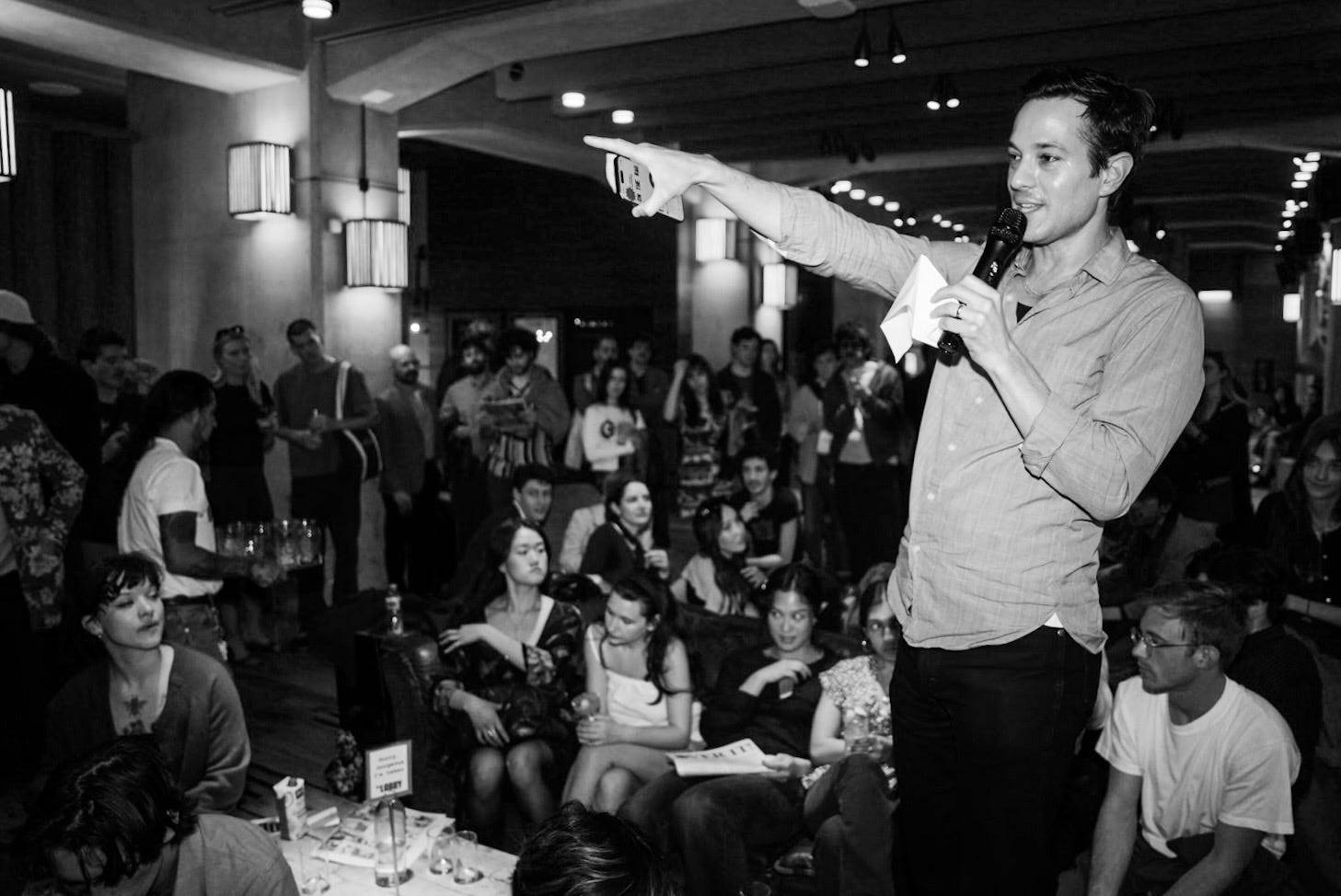
Here’s a party report for the May 2026 launch of the second issue of On The Rag, a “literary magazine-slash-salacious tabloid” run by an extrovert named Sammy Loren. A couple hundred New York media characters and their orbiters crowded into the Ace Hotel Brooklyn for the event. “A BREEDING GROUND FOR THE WORST OF HUMANITY!” boasts the tabloid’s front cover. Poems were read. But this party itself is mostly a pretext for my vomit of memories about writers traveling back and forth between New York, Los Angeles, and Mexico City.
***
I met Sammy in summer 2023. He emailed me saying he would be in New York for a month and throwing a bunch of guerilla poetry readings—“Casual Encountersz”—like he was doing in LA, where he lives, and was wondering if I’d like to read at one of them in New York. I looked him up and saw an LA Times article about hipsters reading poetry in parking lots, taking pictures of themselves reading poetry in parking lots.
This one was in a Ritz-Carlton hotel room, against the backdrop of the Manhattan skyline. The readers themselves were very Bushwick. Most of them were libertines, some of them for money, and one of their clients booked the room. I remember some verses about orgies and licking clits and the Popeyes at Myrtle and Broadway. The reading ended with a bunch of women in lingerie having a pillow fight on the bed.
Then, a few months later, I’m explaining to him why his Instagram comments are under a barrage of attack from Bimbo Terrorismo. I wish I remembered what exactly she was saying. Probably that he was stupid, vapid, a shameless bourgeois self-promoter, a self-mythologizer, a producer of neomemories, which is a kind of libidinal fascism, the kind associated with me, that he was a pedestalizer of fascist e-girl pussy, the “anorexic poetesses, writing paeans to the sexual prowess of machines” against the backdrop of femicided genocided ecocided bodies, of planetary annihilation, that a writer’s job should be to dispel the obvious fakeness of the supposed erotic glamor of fascism, which is to say, that he’s a cuck, or a cuck’s cuck. Something like that.
Sammy called me from LA and asked who Bimbo Terrorismo was. In between the comments under Sammy’s pictures she was posting IG stories about stroking her huge cock to the idea of humiliating me and ruining my life and forcing me to disappear forever, to go back to the Virginia suburbs, that even death was too good for me.
So, whoever this person was, they had to know me somehow.
I told him that Bimbo Terrorismo was named Leila. I said that she had been my guru, my psychoanalyst, my teacher in being an accursed poet, that she was an heiress of Bolaño and Genet and Céline, that she was a fellow child of the Northern Virginia deep state who spent the waning years of the Pink Tide slumming it with leftists in Santiago and Buenos Aires and was now doing the same with sex workers in the Bay, that we had a fruitful period of creative collaboration, that she was part of the same literary movement I considered myself part of, that I had been showing her novel manuscript to agents and publishers around New York, that she writes a sort of écriture feminine, that she was a genius, a mad genius, that she was an oasis of genius in a desert of mediocrity. And, of course, that we were now mortal enemies.
Fascinating, Sammy said, she should read at Casual Encountersz.
About a month before that, I drove from New York to California with Tai, my skinhead dyke former buddy in writing party reports, which we considered a front in proletarian people’s war on the cultural plane.
In Los Angeles, we met Sammy and the other west coast writers and got roped into their little dramas. There was a power struggle over the control of a small literary reading series. A young upstart LA salonnière versus a cancelled older media guy with Thiel connections who was personal friends with the owner of the venue where the readings usually happened. The girl needed a new venue to preempt the coup. We ended up hosting a reading on the rooftop of the Ace Hotel in Downtown LA.
The crowd that showed up resembled a New York reading, but the scenesters were predictably more attractive. Sammy was their arch-schmoozer, the scene’s bicoastal connective tissue. Several of these scenesters are now On The Rag editors at large or New York reading series hosts. Tai and I took mushrooms. Tai hated the readings and grumbled loudly throughout them. When do we start shooting, she asked me. At some point Sammy asked me to read, but I was too trippy and froze. Tai got up and made a rambling speech threatening to hang the Thiel-connected man from the rooftop of the Ace Hotel.
Tai and I left LA for the Bay, where we stayed with Leila, who Tai had not yet met. Those two hit it off even better than I expected, and after Tai and I got back to New York they staged a coup over the authorship of this Substack. And that was the end of my Maoist period.
***
A year later, the summer of 2024. Sammy’s lovely fiancé Mamie is staging a modern dance interpretation of Euripides at Gasda’s theater in Greenpoint. (I was the one who set up the connection, I think.) The night of Mamie’s show happens to be while Bernardo, “Padrote Drogado,” my friend from Mexico City, is in town, and he accompanies me. Afterwards we go to a diner in Greenpoint. Sammy speaks Spanish and knows Mexico City pretty well, including some of Bernardo’s friends.
Unsurprisingly, we talk about Bolaño. Bernardo thinks that there’s something misleading in how Bolaño talks about his exile. It’s true that writers were tortured and killed under Pinochet, and that Bolaño was briefly imprisoned by the regime, though not tortured. Bernardo speculates that Bolaño knew that he would’ve survived had he stayed in Chile, and maybe he was embarrassed by that. Bolaño was a leftist, and no fake leftist, but still an ambivalent one. He could mingle with the poet children of the Latin American bourgeoisie just as he could with the bohemians from the working classes. “Kidnapping Octavio Paz” in Savage Detectives was kayfabe, essentially. Bolaño liked the idea of being a literary terrorist, though he also ultimately made peace with Paz and his groupies. He knew he couldn’t claim to be a true terrorist. And there were certainly leftists that hated Bolaño when he was alive, though now everyone celebrates him. And we can’t forget Bolaño’s fascination with fascism. But who knows, maybe he would’ve been ultimately killed under Pinochet, maybe not. In any case, Bolaño liked exile, Bernardo says, and he liked being an exile. He cherished it in all its bitterness.
The next day, Sammy and Mamie go back to California and get married.
***
At some point, I forget when exactly, Sammy starts OnTheRag.vip, an anonymous message board for literary scene gossip. The message board’s threads concern such subjects as the hottest niche writers and the coolest bars to go to in LA. There are plans to launch an accompanying litmag by the same name.
In the spring of 2025 I attend the New York launch for the first issue of On the Rag. On the cover is a picture of the novelist Marlowe Granados. Marlowe wrote a picaresque novel called Happy Hour that I partially imitated when I started writing New York party reports.
I don’t end up getting a copy of the tabloid, or if I did, I’ve since lost it.
I learn of the contents of the magazine from an article about a launch party in LA that runs in The Hollywood Reporter in June 2025:
“Imagine if The New Yorker drunkenly knocked up the National Enquirer,” Loren recently told Emily Sundberg of On The Rag for her Feed Me substack. “On The Rag is also spiritually indebted to Mexico’s highly Freudian tabloids, which often publish pics of corpses beside porn stars.” Here, the juxtaposition is high-brow lit with dirty pics.
At the time of this launch party, I’m dating Arielle, whose friends are all suspicious of me. This is a story I’ve already partially told in this Substack.
That night, after the On The Rag party, I go to Sophie Kemp’s Paradise Logic book launch at Funny Bar in the Lower East Side and Charley, one of the edgelord burnouts who appears in this Substack, has a racist meltdown that ends with him yelling antisemitic slurs at Daniel Kolitz, author of the Harper’s gooner article, and John Ganz, prominent Substack critic of the New Right and author of When the Clock Broke. I end up taking the blame for this because the narrative ends up being that I brought Charley to the party, which wasn’t true (people like Charley are always at, say, the Forever Magazine parties, the On The Rag parties, and so on, for the same reason they’d be at the Honor Levy book launch, and they were here before I ever got to New York…). Ganz already hated me and would randomly attack me on Twitter.
The issue was that Arielle and Ganz had mutual writer friends, Ganz is taken more seriously than I am among them, neither she nor I wanted the friction, and so it ruled out beefing with him. So when I saw Ganz at the party, I had thought for a moment that it could be a good opportunity to bury the hatchet and disprove whatever toxic or disagreeable image that Arielle’s friends had of me. (Bolaño liked the idea of being a literary terrorist, though he also ultimately made peace with Paz and his groupies…) Obviously, that doesn’t happen.
A month or so later I run into Sammy in front of the Lassens on Sunset Boulevard, and then we hang out on the porch of the house in Echo Park where Arielle and I are staying. I forget what exactly we talk about. Probably everything I know about who’s fucking who in the New York scene.
Back in New York Arielle sends me a text with a link to a thread from the On The Rag website where an anonymous poster claims to have made out with me at some party. She says one of her friends was reading the site and sent it to her. I’m pretty sure the story is fake. I tell her that it’s fake and that it was probably just posted by Sammy himself, like everything else on the website, it’s all fake and he’s gassing us all up to make us seem more sexy and notorious and whatever.
***
In December 2025 Sammy sends me a picture of Lupe at La Americana in Mexico City. “Making friends,” he says. A pang of guilt. I imagine what they’re talking about. She’s almost certainly mad at me for ignoring her, and probably for other things too. He probably tells her to write about it for On The Rag. Sometime in the new year Dove, who came with me to Mexico when I met Lupe, sends me a thread from the site posted in Spanish.
Then, later, Dove tells me that Lupe has been messaging Jean-Baptiste. And now apparently Lupe’s planning to visit Jean-Baptiste in Paris. Then they’ll both come back to New York. I tell Dove that Jean-Baptiste is probably already in love with Lupe, and good for him.
Jean-Baptiste, that mustachioed French journalist who came to New York to research Dimes Square, who hung out with the edgelord burnout crowd (he was fascinated by the “art brut” poems of characters like Charley), and who fell hopelessly in love with their patron salonnière, Cassidy. (If the briefest portrait is the object of imitation, Cassidy’s is Anaïs Nin.) This would all become material for Jean-Baptiste’s novel.
Dove recalls a particular Charley memory from something like two years ago. Dove’s at someone’s apartment somewhere sometime late at night in the heroic depths of cocaine intoxication. Adrian, who is dating Cassidy at the time, proposes a threesome to Dove. “I wouldn’t just offer this with anyone, but you know, you, me, Cass—could be hot! Whaddya say?” And Charley is in the corner, even more fucked up, evidently confusing ménage à trois with coup de grâce. Are we gonna have a coup de grâce? he keeps muttering under his breath. A coup de grâce? We’re gonna have a coup de grâce? A coup de grâce?
In May 2026, Dove sends me a screenshot of an Instagram story from Lupe. A dimly lit photo of an art studio or backstage space, a large bucket with murky pinkish water in the foreground, red paint-like streaks dripping down the bucket and smeared across the floor. A wooden chair in the background with clothing draped over it, dark curtains hanging behind everything. Overlaid in large white text is the caption, in English: “When the gringo writes about me on Substack.”
***
On the night of the downtown LA Ace Hotel rooftop reading in 2023, with Sammy and all the LA scenesters, Tai and I met a crust punk named Priy. For some reason I felt comfortable talking to Priy. She seemed like a sort of familiar outsider. She invited me and Tai to come back to her place in Silver Lake. At her apartment, she told us that she had borderline personality disorder, and that her father is a powerful haute-bourgeois pedophile responsible for trafficking young girls.
“With a father like mine,” she said, “how could you not be BPD?”
Priy poured us huge glasses of tequila and orange juice while I ground up weed for a joint.
“You know Caroline Calloway, right?” she asked me.
Caroline Calloway, the writer-influencer-scammer who promoted my writing early on in my time in New York. I do know her, though we hadn’t yet met in person.
“Tell me about her. I went to Cambridge, like her. I’m fascinated by her whole persona. I love her writing. I’m interested in your connection to her.”
I told Priy everything I had to say about Caroline Calloway. Priy kept playing different songs that reminded her of Caroline and of Cambridge, but she would switch them after 30 seconds. Pick a song and stick to it, Tai said.
Priy went into her bedroom and came back with a large notebook full of her handwritten poems. She read us one. It was a love poem, one that was aware of itself, anxious about whether love can be made rather than merely felt. Love appeared as bacteria, an infection, a contamination. The speaker addressed a lover with both male and female qualities, someone smarter, cooler, more composed. By the end, the poem dissolved into pure, almost glossolalic rhythm. When she finished, the room was quiet for a moment as Tai and I thought about it.
“Can I be brutally honest with you?” Priy asked me.
“Of course.”
“I think your writing is superficial. And that you’re a clout chaser. You probably should just stop writing. You’d get more depth from any random homeless person off the streets than the usual characters you engage with.”
“I see.”
“You should ask yourself what it is you’re really doing.” she said. “Do you love yourself?”
Tai shifted on the couch and the joint went out between us.
Priy left for the bathroom, leaving Tai and I alone. After several minutes of silence, we started to hear muffled noises coming from the bathroom, as if she were talking to herself, or maybe sobbing.
At some point it seemed like it had gotten late. We ended up calling a car while Priy was still away. Before we could tell her, I got a text:
will you stay?
The car was already outside. We found ourselves awkwardly calling out to Priy announcing our departure. She finally emerged from the bathroom as we walked out the front door.
After we left she texted again:
rude you guys bolted
i hope it was fun I guess y’all just tripping
nice to meet you
About two months later, after my falling out with Tai and Leila, I saw on Leila’s Instagram grid a gnarly picture of Priy and Leila together naked, licking each other. Then about a month after that, Leila published a blog post about her tumultuous breakup with Priy.
There’s a passage in the piece about watching a Peter Vack movie. To give you an idea of the prose style that has profoundly shaped my own:
We watch Peter Vack’s movies in bed, in disgust. White bourgeois art is child porn, she says: depravity, the sadistic murder, torture, rape of women and children. For all that fascism has become meta and subtextual and hidden in a mise en abyme of self-referential solipsism, it’s still ultimately about the ego, the white ego in its death throes, they plumb new depraved depths of themselves because they have nothing else, no collective effervescence, consciousness of love, beauty, sex appeal, nothing. We talk about us in the future, a guerrilla cell of two assassinating these fascist artists, in semi-clandestinity (but also as publicity for our first books, brilliant and murderous), starting with xxx: an underground war against bad art, first of all, and only then against fascism, though for both of us bad art and fascism are indistinguishable, ultimately, there’s no fascism that’s not bad art, no bad art that’s not fascist, etc.
I suspect that “xxx” refers to me. The former member of the guerilla cell assassinating Peter Vack.
Sometime later, long after the breakup, Priy tags me, Peter Vack, Dasha, Sighswoon, and some others I forget in a series of Instagram stories about how we are all child pornographers. I regret not saving a screenshot, and sometime even later I message Peter asking if he remembers this (he does) and if he had saved it (he didn’t, he didn’t think anything of it at the time).
***
A year before, when I was still in Leila’s guerilla cell. n+1 had just published a big essay about the Mexican writer Heriberto Yépez called “In Praise of the Terrorist.” I asked Leila if she knew his work.
Yes, I seriously love him. He’s like an autocancelled anticolonial poet mystic text artist from Tijuana, with like a bunch of different guises and personae. I especially love Empire of Neomemory, just this brilliant caustic troll… He goes after a lot of the same avant-garde pieties as you. Basically calls the whole historical avant-garde fascist.
The unhinged outsider critic of the Mexico City scene. I thought about going to Mexico. Yépez’s libidinal anti-imperialism ironically turns him into a tour guide for a sort of monstrous vacationing gringo wanderlust.
Sometime in September 2022 Dasha messaged me asking for book recommendations about fascism. “What are you interested in, in particular?” I asked her. “Idk, like the basics,” Dasha said, “like not Male Fantasies, I guess something about how it’s bad?”
I sent a screenshot to Leila. “I feel like you should recommend Empire of Neomemory, unironically,” she replied. “Yépez’s Nietzschean vitalism might actually soften the blow.”
That was also the time I met Bernardo on Twitter. Back then he was “Mexican angelicism” to me, since he had a Substack that was influenced by angelicism. I didn’t know him long enough to know his creative particularities. I wasn’t sure yet whether he was cool or not (I considered angelicism an aesthetic enemy of mine, a rival cell). All I knew was that he was someone who lived in Mexico City and had the same interest in weird internet subcultures and the downtown New York world as I did. To me, Bernardo basically represented being legible beyond New York.
“Mexican angelicism has such a mystical ring to it,” Leila said to me, “Like Mexican surrealism, or Mexican anarchism. Historically, the Mexico scene makes more sense. Like Europe and Latin America traditionally have a politically and culturally limp right-wing wannabe avant-garde that Bolaño writes about in pretty much every book. The U.S. doesn’t, or didn’t, at least not in the same way. Pound and Eliot and Wyndham Lewis went to Europe. The New York scene is imitative of Mexico and doesn’t even know it.”
Ironically, angelicism itself was essentially a British attempt to imitate the New York scene. Which is to say, Bernardo was imitating something that was always already an imitation of himself.
That was also why, in Mexico City in 2025, I found it so ironic that Curtis Yarvin had refused Lizardi’s offer to translate Unqualified Reservations into Spanish. (Lizardi, the 20-year-old Twitter Falangist, who would’ve been a darling of Sovereign House had he lived here instead.) But maybe it’s for the best that our own fascists are so provincial.
***
I didn’t end up seeing Sammy on that trip. I think I missed him by a couple weeks.
This past January, Dove stayed at Sammy’s second apartment in Highland Park for a couple days after shooting the AVN awards. When he was there he hung out with a puppeteer Sammy was also putting up.
It’s probably worth noting at some point that Sammy isn’t even from LA originally. He’s from Kansas.
***
What is this Substack? A D.I.Y. neomemory. A cinematographic loop of decontextualized images of literary readings, parties, eccentric characters, and so on, that simultaneously takes place in an immediate now (that party the other night…) and in a hallucination of all history (…the 60s, the Weimar Republic, the Belle Époque, classical antiquity, whenever you like…). A camera gaze that devours everything that it encounters. The construction of an artificial history. A cottage industry for the production of ideology. A fantasy of the world ripe for my ghastly taking. The illusion of what Yépez calls pantopia. New York, Los Angeles, Mexico City. A continent that can fit everything in existence. Even a critique itself is just another machine for the neomemory’s production.
The wildest, most outrageous ambition: to say anything real about “American literature.”
Then, Bernardo again, messaging me:
As for the inherent fatalism in Mexican thought and culture, much has been written about that. The author of that n+1 piece calls it “mexicopessimism,” but I prefer to call it “pornomiseria,” because I feel Mexicans have a morbid and ancestral obsession with defeat, with death, with violence. And I agree with Yépez that we need to create a new Mexican identity which is necessarily anti-Mexican, or non-Mexican, to evade that defeatism. I have been working on that through writing, in the “new” Mexican, the Antimexican, the Astromexican as I have called it, but I still don’t have a finished idea of it.
In 2024, the author of the n+1 essay on Yépez—the son of Eduardo Medina-Mora Icaza, an apparatchik of Mexico’s drug war state who resigned from the Supreme Court in 2019 amid scrutiny over suspicious financial transfers—publishes an autofiction novel that Mexico City Twitter promptly skewers. The book is published in English and the synopsis on the jacket has the sort of woke language that caters to liberal gringo sensibilities, which isn’t entirely fair to the contents of the book. Still, the viral tweets ridiculing it are a bloodbath.
In the comments, Bernardo is a lone voice defending Medina-Mora. “No entienden la profunda soledad del whitexican.”
Later, I’m walking around Doctores with Lupe, and I tell her about this story and Bernardo’s running “whitexican” bit. Bernardo and Medina-Mora and that whole milieu aren’t really whitexicans she says, at least not how she understands it. She says that whitexicans are tacky basic normies who specifically imitate tacky basic normie gringo culture, who wear yoga pants and Uggs and shop at this one particular mall on the outskirts of Mexico City, and some other things I forget. Medina-Mora self-deprecatingly considers himself a holdover from a more baroque, Habsburg age. Bernardo comes from a lower tier of the elite (he went to UNAM rather than Yale) but his wife and her friends inhabit a more Europe-focused haute couture lifeworld. They’re something else. Which I guess explains the joke.
***
When I get to the Ace Hotel Brooklyn May 2026 On The Rag launch party there’s something ambiently “2022” about the scene somehow. There’s a few hundred people, the biggest for something like this I’ve seen in a while. I recognize a bunch of people who appear in this Substack I haven’t seen in a few years. They look the same, just slightly older, and slightly less mysterious.
In the magazine, there’s a short article by OTR nightlife editor Zoey Greenwald called “OVER IT!” that opens with the graf: “Dimes square is over. Choose your death rattle: rape or drug addiction.” Without mentioning names, the piece alludes to scandal surrounding predatory male orbiters and the discourse around buzzy debut novels by sceney women in their mid-twenties. Something new is coming, the piece promises, “like, some new crop of angel-saint-cyborg-prophets sent to save the absolute scum of humanity from the impending absence of culture/arts and letters.”
Arielle, a different Arielle, who panned both Honor Levy’s My First Book and Sophie Kemp’s Paradise Logic in The Baffler, reads at the party.
I am tired, and I hide in the corner the entire time. I am much less anonymous now than four years ago. Then afterwards I feel too lazy to start writing this party report. I ask Dove for his report a day later.
For one, Caroline Calloway didn’t recognize me, despite us hanging out for five hours some other time… she had even made a drawing of me that time… the drawing is on my refrigerator… she accused me of fabricating the memory… it was kinda funny because she had been talking to me as if we were familiar. She told me that I had predator vibes to her prey vibes. But she asked for my number and said she has women she wants to set me up with.
Sounds about right. At the party Caroline spotted me early on and ran over to me. She was with a man she said was her boyfriend. Coincidentally, I had met him at a wedding just a few days prior. (Less than a week after this party, Caroline posts an Instagram story saying that her boyfriend broke up with her.) Caroline’s likeness brings me back to Priy, the night in LA in 2023, the conversation at her house in Silver Lake (You should ask yourself what it is you’re really doing… Do you love yourself?), and then to the Ace Hotel rooftop where I met her.
XXX is kinda obviously fucking YYY. She was talking with ZZZ and Moldovan was getting jealous and kinda growling and she was placating him by putting her arm on his leg and whatnot.
Moldovan is “Future Moldovan Citizen,” a downtown right-wing party promoter who used to help run Sovereign House.
Sophie was stepping out of my camera range but Madeline yoinked her into frame for the shot.
Donovan was hanging out with a bunch of South Africans that were trying to scam the U.S. into an entry visa, but they’re all socialist artists, so it’s not going well.
This girl who is friends with Peter Thiel, one of his “proteges,” came up to me and praised my Vice article about Nick Land, and told me she is using it in some book she is writing. Then this other girl, who is critical of that entire world, also praised the piece. So, I’m not sure what exactly that means.
Other than that, I don’t know. Peter Vack seemed to be charming the Punisher girls.
I needed a fight to get things interesting.
There’s also the Ross Barkan–John Ganz beef. But I think nothing happened, they were just in the same room. Sammy claimed in the OTR story that they brokered peace but it was probably just trolling.
Barkan and Ganz had a Substack livestream sometime at the end of December, one more instance of the interminable online debate over whether “fascism” is the right term to describe Trump and everything else. Ganz was more correct but Barkan is more personally tolerable. But Ganz being there—that’s a hook I can work with.
Wait, so Ganz was there? I asked Dove. Did you get a picture?
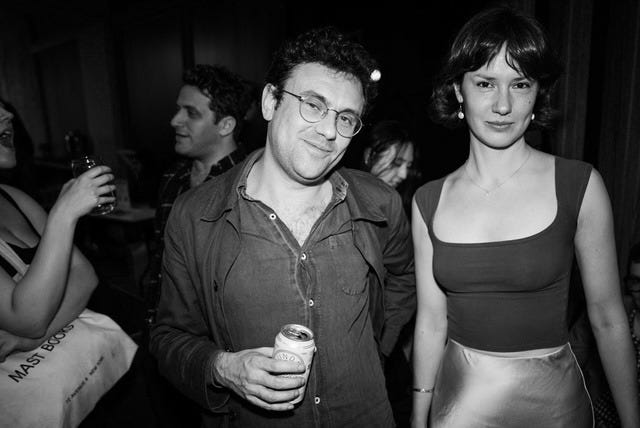
And I actually did try to broker peace with Ganz myself, the last time I saw him. That was at a New Year’s Eve party at Sevilla in the West Village put on by some other gang of scenesters. I pulled up to the restaurant and immediately saw him through the window, sitting at a booth between Cassidy (the same libertine who broke Jean-Baptiste’s heart, among other hearts) and Sophia (a niche Twitter personality with conservative inclinations I remembered from my time in DC; I have a memory of her coming over to my apartment in Arlington once with a group of people, though I mostly forget why)—Ganz was sitting between two ideologically compromised women I happened to be friendly with. Perhaps I could warn Substack’s preeminent antifascist pundit about them.
I approached Ganz while he was smoking outside with Christian Lorentzen and said that we should squash our beef. He was silent for a moment. He started trembling a little, almost like he was powering up. The righteous indignation of the respectable New York intellectual world. Once he activated, he said that he had no interest in having a conversation with me, that I should just fuck off, that he didn’t respect me or my work, he wants no part of it, in fact that he found my entire project and persona frankly disgusting, that I was a nobody, that I wasn’t from New York, that I was just a transplant, that I had no right to be here, that I was a schmuck—yes, he even brought out the Yiddish.
I didn’t have much more to say after that. What exactly is so disgusting remains elusive. If he wants no part of my work, he’s still the one picking fights with me on Twitter. No matter. I basically stood there making his smoke break as awkward and uncomfortable as possible.
Lorentzen was the only witness to that encounter, but the next time I ran into Sammy he had heard about it. I don’t get your feud with Ganz, he said, but you should write about it for On The Rag, it’s great content.
confusing ménage à trois with coup de grâce is truly one of the funniest goofs of all time
this was a great piece Mike. I really appreciate the throughline contending with Bolaño. hope you're okay <3
The best of all the crumpstacksz